| IN TOUCH |
| HELLO CLAY COMMUNITY It’s a safe assumption that an overwhelming majority of us have a favorite mug – one that household members know not to touch, lest they incur our silent wrath as we shoot daggers at them from across breakfast table. There’s a certain intimacy inherent in functional, handmade pottery. Whether it’s the aforementioned favorite cup that makes coffee taste better, owing to some alchemical combination of formal elements and an unquantifiable magic the artist brings to the work, or a serving bowl that makes an appearance at most dinners and family gatherings, these pieces are woven into the backdrop of our lives; bearing silent witness to the glorious monotony of our daily rituals and standing by during moments of connection, profound joy, pain and quiet contemplation. This month APA is in studio with Bob and Connie Pike, Alberta artists whose passion for clay figures large in their personal and professional histories. Both have spent time as production potters, and with 350 000 pounds worth of pots with their mark on it, you’re likely to see one of their pieces in a kitchen cupboard near you! In Studio With : Connie and Bob Pike |
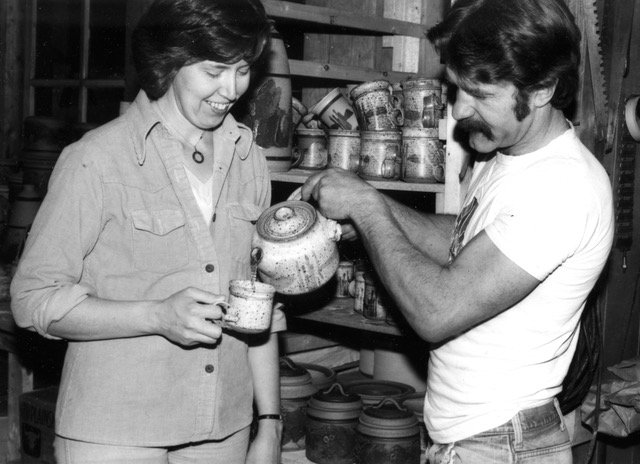
| IN STUDIO WITH: CONNIE AND BOB PIKE By Roberta Binotto The latest iteration of Pike Studios occupies a corner lot in High River’s light industrial area. It’s here that APA member Connie Pike and her husband Bob spend their days creating. The couple sat down with me one January afternoon to trace their individual and collective histories in the arts community. Although each started working with clay before their paths crossed, theirs is a shared journey that spans decades. Connie continues to work with clay, balancing production pottery with experimentation and explorations of form and surface decoration techniques. These days, Bob’s creative focus has shifted to metalwork, and painting after learning that he was allergic to clay mold in 1981.I’m greeted warmly by Connie and Louie, a feisty miniature schnauzer who, after some enthusiastic protestations and a cursory sniff, deems me a non-threat and allows me to pet him. Inside the small industrial building are three bays, the middle of which is a ceramics and art gallery. There’s an impressive kiln room at the back, and Connie and Bob have their own studio.Connie is already well into recounting the early days of her clay journey when she pauses to put the kettle on. Bob wanders in a short time later, seamlessly picking up where Connie left off. He backtracks a bit, reminiscing about his early days, which Connie jokingly qualifies as ‘B.C.’ (Before Connie). Our conversation is meandering, with fascinating asides: tales of early opportunities and challenges, advice for new potters (gleaned, no doubt from their considerable experience), reflections on the early days, anecdotes of other prominent Canadian ceramicists who ran in the same circles, and frequent pauses to conduct internet searches to show me the work of said artists. It quickly becomes apparent that an afternoon is not nearly enough time to cover two lifetimes-worth of creativity and I start to wonder how soon I can return for another visit without seeming like a nuisance.Born from a fascination with the medium in the early 70’s, their clay stories are characterized by their artistic sensibilities, enterprising spirits, commitment to honing their craft and a habit of going with the flow, seizing the opportunities that presented themselves, and creating opportunities where there were possible. Connie was first exposed to clay while living in Peace River and recalls making a bowl on a wheel that “had two speeds: slow and slower.” The bowl was not especially memorable, but her interest was piqued. During her time in Peace River, she attended a workshop with Pierre Guy, a ceramicist associated with Alberta Culture. His handbuilding demonstration opened her to the possibilities inherent in clay. The rest of her story reads like a series of auspicious opportunities: scholarships, 4 and six week sessions in Banff, teaching gigs, and a friend with a studio and a gas kiln, all of which started her down the path toward becoming a career artist. |
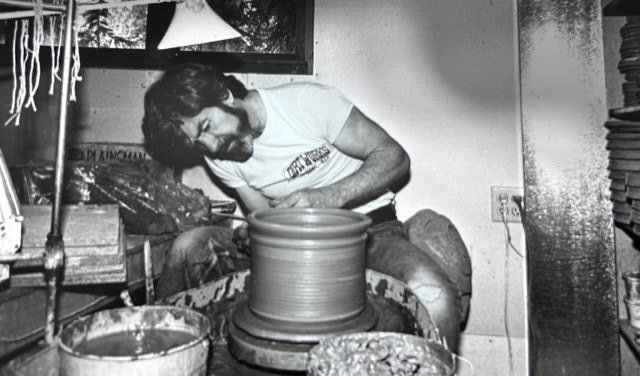 |
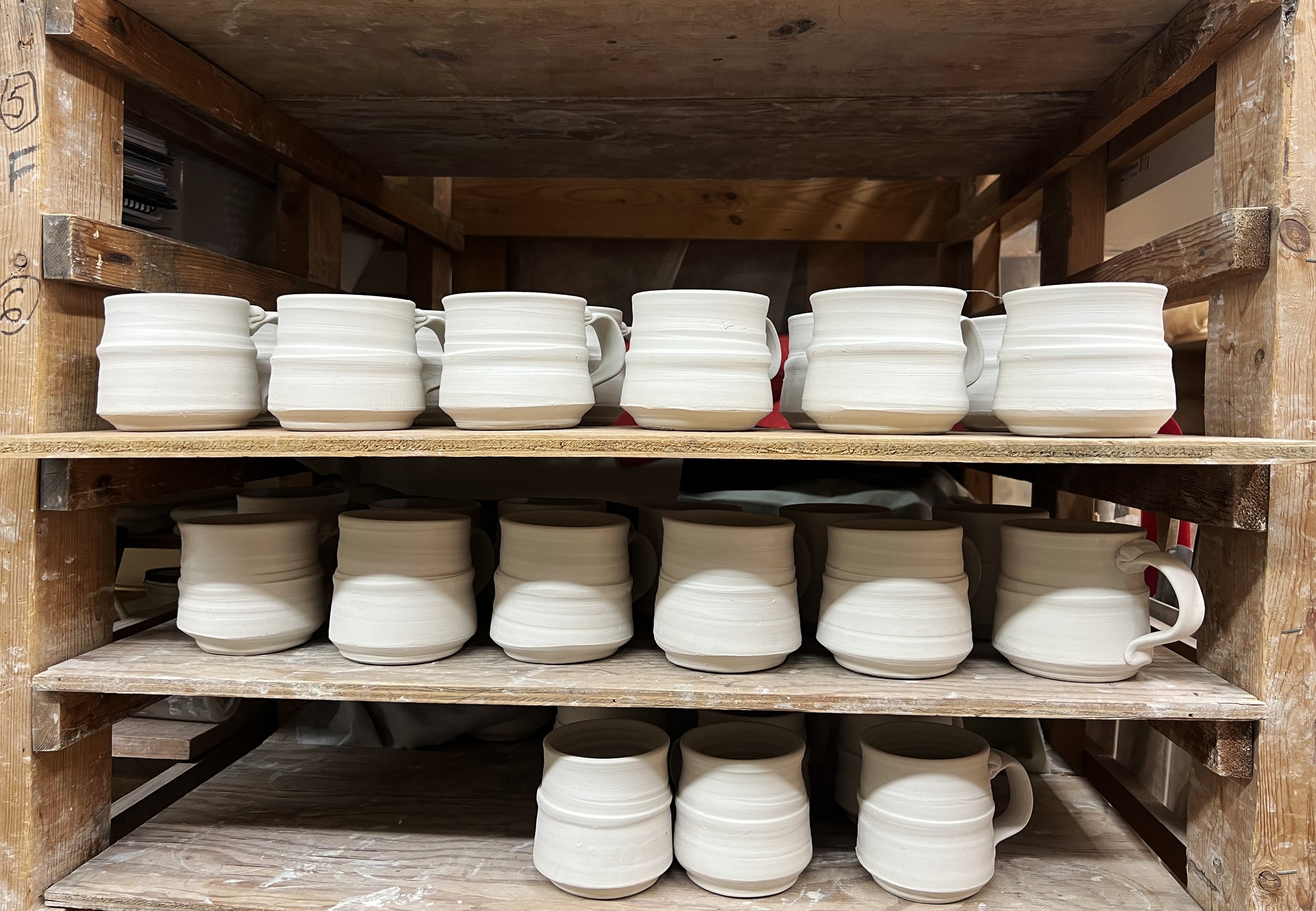
| In the early 1960’s, Bob had taken sculpture at ACAD, and was familiar with clay. A free spirit, he spent the later part of that same decade living in California and Montreal to experience the vibrant arts and music scene. When presented with the opportunity to take over a friend’s ceramics studio in the Eau Claire district in Calgary in 1971, he decided to try his hand at production pottery. The city-owned studio had no running water and the storage system was woefully inadequate. Bob addressed this issue quickly, developing a modular shelving system to take advantage of the vertical space. It needed to be flexible enough to accommodate work of different sizes. The Pike’s continue to use this system to this day, adding sections of shelves as required, and wrapping sections in poly to create a damp room. While he was making pots in Calgary, Bob recalls an Edmonton store phoning him up to every so to order an entire kiln load from his 40 cubic foot kiln, sight unseen. Throwing planters became an everyday affair. The Pikes met in 1977 while Connie was taking a month-long course from Carleton Ball. About a year later, they decided to set up together in Lavoy, Alberta, just east of Vegreville, where Connie was born. Their production pottery studio featured a 60 cubic foot kiln designed and built by Bob. Ceramics were in high demand at the time. Craft stores began to appear and one could, with dedication and hard work, make a good living. |
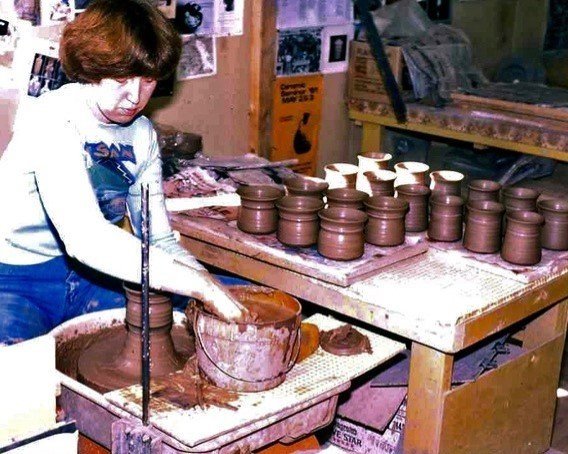
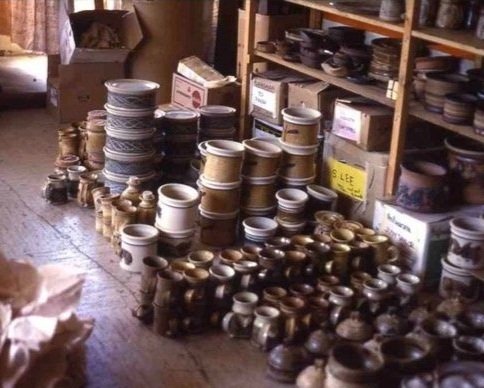
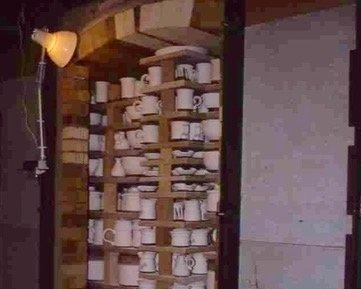
| ON HOW TO BE A WORKING ARTIST : BALANCING RESPONSIBILITY WITH ARTISTIC IMPULSEBoth artists have maintained an art practice separate from their work, and this is evident in their gallery, where production wares rub shoulders with a variety of one-of a kind pieces, metal sculptures and paintings. Bob’s approach is pragmatic. “you gotta pay rent and feed your kids […] then you go into the studio at night and do your art.” Always looking for ways to become more efficient, he saved time on production pieces by throwing off the hump. He also opted out of trimming a foot on his production ware. Instead, he would define the pot’s base with the help of an ear syringe and a pointed stick, cutting it at an angle before taking it off the wheel. Connie is constantly challenging herself to make each pot better than the last, and it shows. If you haven’t sipped tea from one of her mugs, you’re missing out on what is arguably one of the most comfortable handle experiences. |
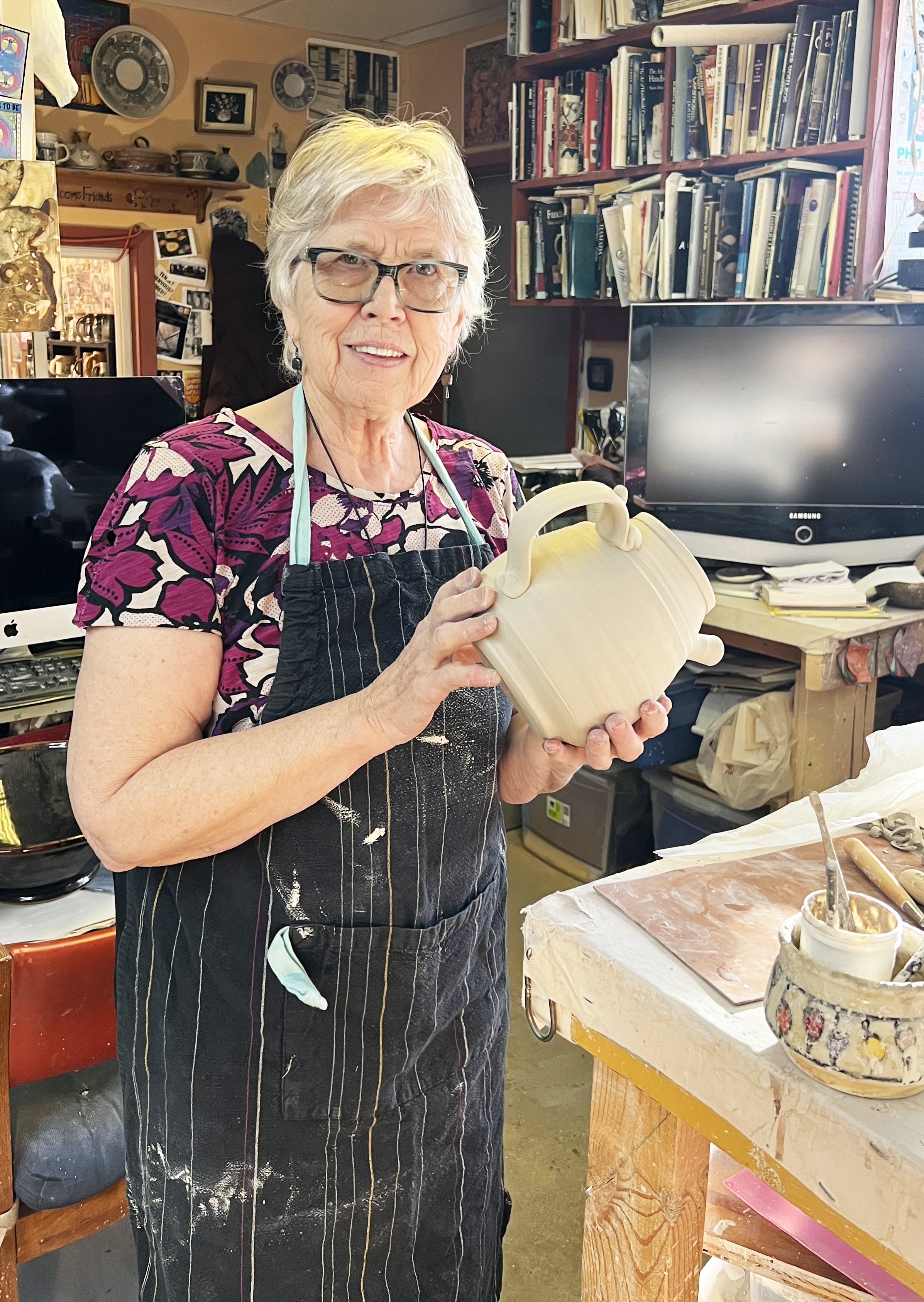
ON THE CREATIVE PROCESSOver time, Connie and Bob have developed their own visual language and approach to creating art, though a quick scan of their studios provides clues that both methodical and their creative processes are iterative, with new pieces and processes evolving from earlier versions. The work, as Bob likes to say, generates the work. Perhaps the biggest difference in their approach to making art is that Bob prefers to create “with blinders on” to avoid being influenced by outside ideas or trends. He considers himself a left-brained artist; a builder who invents or alters tools, which he then uses in new ways. His explorations with clay often challenged accepted methods and processes. 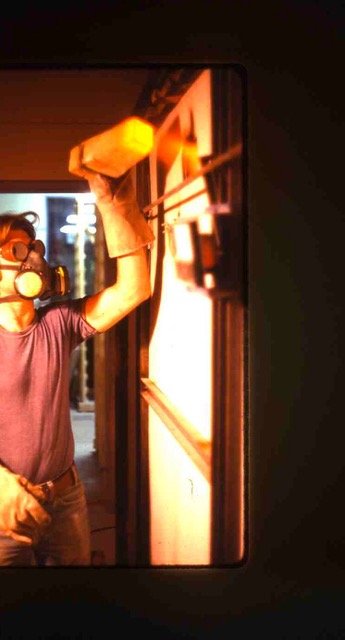 |
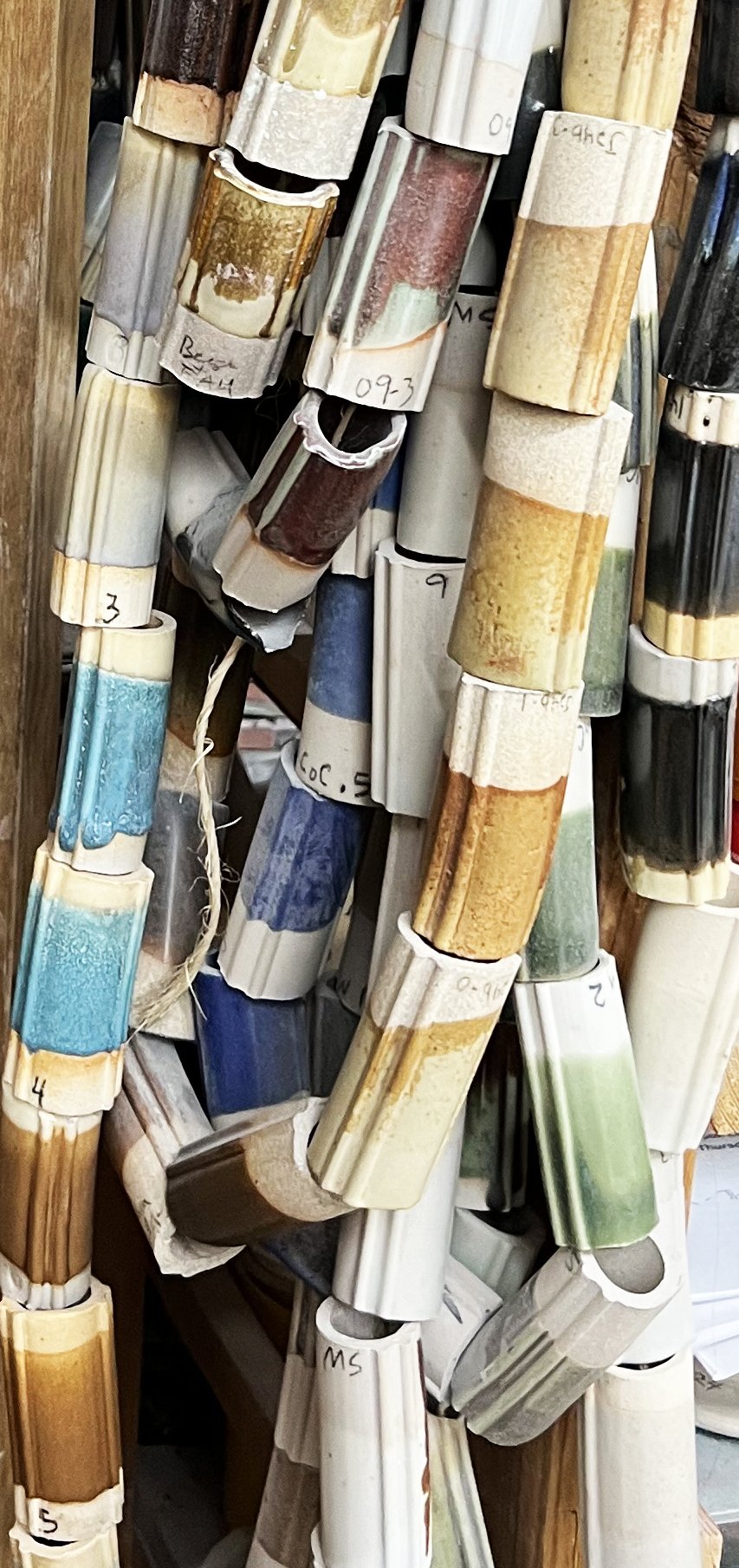 Fascinated with the possibilities of extruders, Bob made his own, complete with complex dies (as featured in The Extruder Book). He experimented with altering the extrusions, slicing them at different angles. From there, he developed a modular decorative tile system that is on display on the back wall of the Pike’s gallery. The wall is composed complex tiles that are extruded, sliced and joined with other extrusions. It’s cool in a modern, effortless sort of way.A lifelong student of clay, Connie has an insatiable appetite for ceramic knowledge, skills, and community, which are integral to her creative process. She is always looking to connect with and learn from other artists. Her work celebrates and builds on contemporary and traditional forms, processes, and techniques. Connie’s methodical approach and curiosity are evident throughout her studio, where glaze and surface decoration test tiles share shelf space with vessels that are markedly different from the production ware. Her inspiration library is enviable, books fill her shelves and posters adorn nearly every vertical surface. Fascinated with the possibilities of extruders, Bob made his own, complete with complex dies (as featured in The Extruder Book). He experimented with altering the extrusions, slicing them at different angles. From there, he developed a modular decorative tile system that is on display on the back wall of the Pike’s gallery. The wall is composed complex tiles that are extruded, sliced and joined with other extrusions. It’s cool in a modern, effortless sort of way.A lifelong student of clay, Connie has an insatiable appetite for ceramic knowledge, skills, and community, which are integral to her creative process. She is always looking to connect with and learn from other artists. Her work celebrates and builds on contemporary and traditional forms, processes, and techniques. Connie’s methodical approach and curiosity are evident throughout her studio, where glaze and surface decoration test tiles share shelf space with vessels that are markedly different from the production ware. Her inspiration library is enviable, books fill her shelves and posters adorn nearly every vertical surface. |
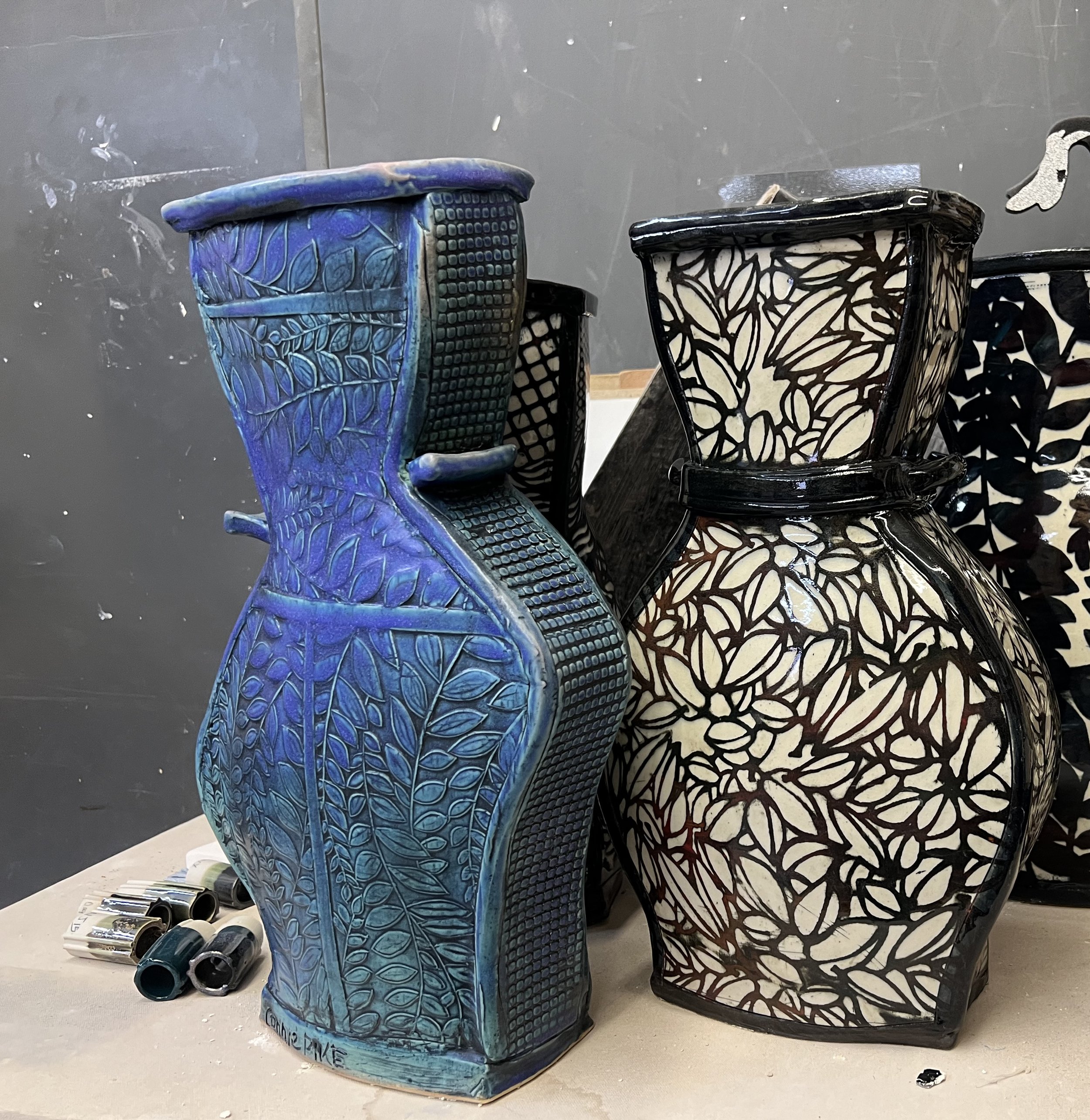 |
| One of Connie’s creative series, currently on display at Willock & Sax gallery in Banff, came about at Medalta during a ceramics master class facilitated by Brendan Tang an instructor at Emily Carr Institute of Art + Design. She had brought with her a series of drawings of quirky patterned vases. On seeing them, Tang urged her not to throw. Make more drawings, he told her; make them bigger. While looking at the drawings, it dawned on her that she could make them into large scale flat vases. The resulting forms, some of which are pictured above, are statement making pieces; unexpected and dynamic. They owe their depth and dimension to patterned and textured surfaces and glaze techniques, which she achieved using carved lino designs and water etching. |
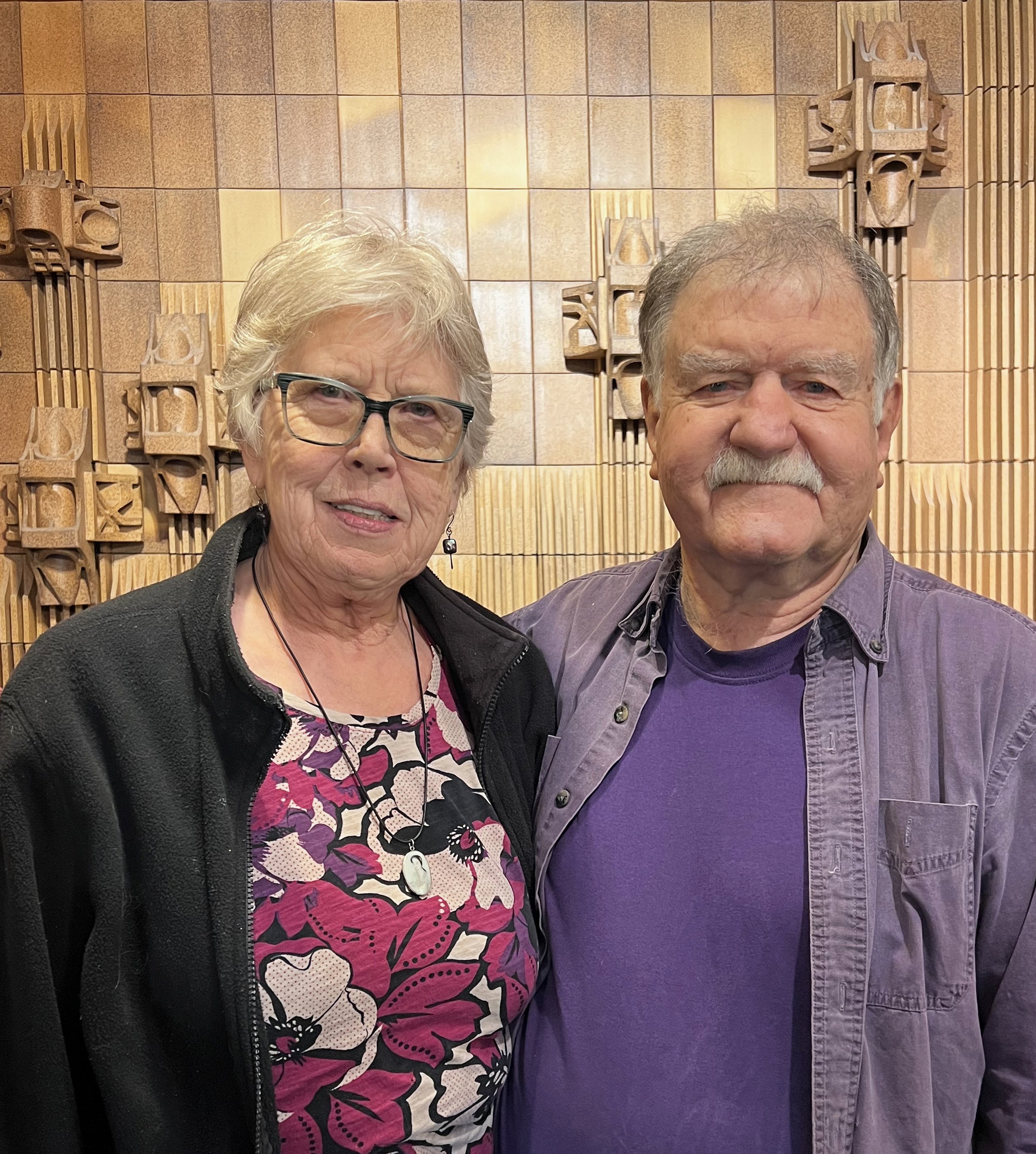 |
| ON WORKING TOGETHER: The pair works flawlessly as a team on all matters relating to the studio, sales and other aspects of their business. Though they shared a studio in Lavoy, separate studios suits them better as it affords them space and freedom to create. Connie sometimes thinks it might be interesting to collaborate with Bob, she recognizes that his process which is at once deeply introspective and conceptual, doesn’t lend itself to working together. Bob agrees. “An artist needs their space.” He illustrates the point with an anecdote from their early days, jokingly framing it as a ‘soul crushing’ moment. At the time, he could throw as many as 175 vessels in a day and Connie, who would throw her own pieces, also waxed, glazed and sanded all the pots with the help of a studio assistant. After a long day spent making production ware, Bob returned to the studio, cranked his music and set to work, “as happy as a clam,” developing an idea that had seized his imagination. “Then, she walks in and turns the music off!” he exclaims, mildly incensed. Connie laughs as Bob continues: “and that’s why now we have her studio, my studio and no-man’s land in the middle.” The Pikes are happy and easy going and will tour you through their studio, talk about the business of clay and art with anyone interested in visiting their studio in High River. Thanks Connie and Bob for your warm welcome and for so generously sharing your time and stories!WORDS OF WISDOM: “Make work everyday…if you don’t know what to make, make mugs and your ideas will flow from there” – Connie“Young potters are worried they won’t be able to fill a large kiln. Learn to throw big pots…throw planters, lamps big things.” – Bob“You have to work, every day if you can. If you’re sitting there, waiting for this big epiphany, it ain’t gonna happen.” – Bob |

This so appreciated!!
I have had the same welcoming experience at Pike Studios. The Pikes are true gems and uber-talented. Also their life-time work ethic is evident in that treasure of a studio. Jaelene M. Sent me this article – for some reason I can’t see my newsletter.
what a well-written and informative article❤️
LikeLiked by 1 person